
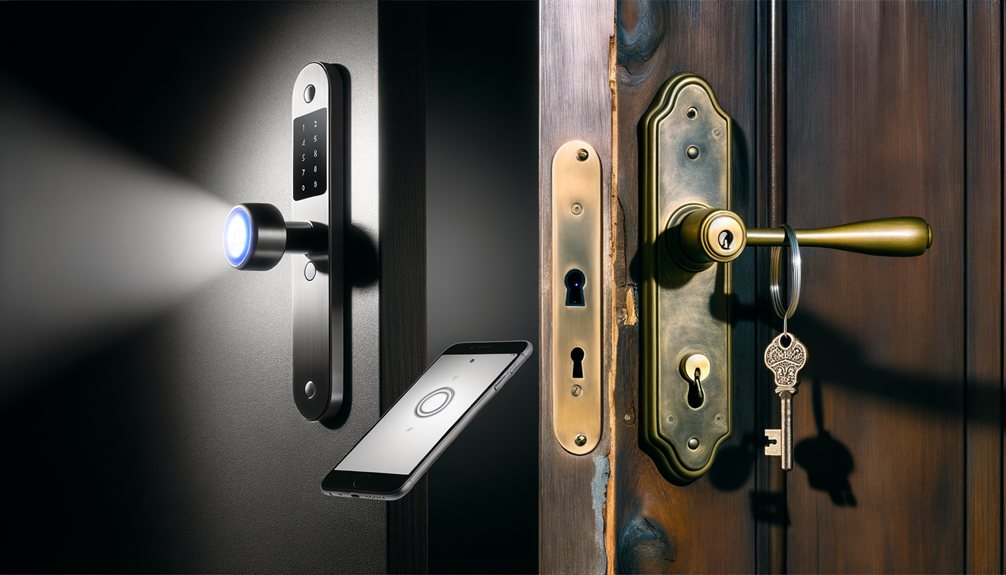
Smart locks and traditional locks perform the same physical function — extending a deadbolt into a reinforced doorframe — but beyond that they operate on entirely different principles with different costs, vulnerabilities, and lifespans. A Grade 1 mechanical deadbolt can last 30 years with basic maintenance. A smart lock operates on a 5–7 year IoT hardware lifecycle tied to active manufacturer support. Understanding that difference is what makes the choice meaningful.
The Core Difference: Mechanics vs. Software
The actuation method is where these two lock types diverge completely, and it’s the source of nearly every tradeoff that follows.
Traditional Locks: The Decades-Long Mechanism
Traditional mechanical locks run on a purely analog system of pins, tumblers, and physical leverage — no motherboard, no firmware, no batteries. A high-quality Grade 1 mechanical deadbolt installed today will function identically in 30 years, assuming basic lubrication and maintenance. That consistency is the core value proposition: absolute reliability with no external dependencies.
Smart Locks: The Tech Lifecycle Trap
A smart lock is, in practical terms, a piece of consumer electronics mounted to your door — and it carries all the risks that implies. When you buy one, you’re dependent on the manufacturer maintaining their cloud servers and API endpoints for the life of the product. If a company goes out of business, sunsets a product line, or deprecates an old API without a backward-compatible firmware patch, your $250 smart lock degrades into an expensive deadbolt you overpaid for. You’re trading a 30-year mechanical lifespan for a 5–7 year IoT hardware cycle.
Security: Physical Vulnerabilities vs. Digital Ones
Vulnerabilities of Traditional Locks
The security flaws of traditional locks are entirely physical. Forced entry — a single kick to a poorly framed door — remains the most common method of residential break-in, and no mechanical deadbolt grade prevents it entirely. Beyond brute force, traditional locks are susceptible to picking, bumping, and drilling. The subtler vulnerability is key management: physical keys can be duplicated quickly and secretly. Losing a key, or discovering an unauthorized copy exists, means calling a locksmith and paying to rekey or replace the cylinder — with no way of knowing who had access in the interim.
Vulnerabilities of Smart Locks
Smart locks introduce digital attack surfaces — local network exploits, Bluetooth spoofing, and companion app vulnerabilities — but the more realistic day-to-day threat is operational failure. A smart lock fails when its batteries die without a physical backup key available. It fails when a botched firmware update bricks the device, or when a cloud server outage cuts off the companion app from communicating with the hardware. These aren’t theoretical edge cases; they’re the failure modes that produce the most real-world lockouts.
Access Management: Where Smart Locks Dominate
The most practical argument for smart locks isn’t security — it’s access control. Hiding a spare key or handing a copy to a contractor are security liabilities that most people accept by default because there’s no better option with traditional hardware. Smart locks eliminate that compromise entirely.
Temporary, time-restricted PIN codes mean a house cleaner or maintenance worker gets access exactly when needed and not a minute longer — no coordination, no key handoff, no follow-up. Every entry is logged with the code used and an exact timestamp, so you always know who came home and when, which is particularly useful for Airbnb hosts managing guest turnovers or families tracking after-school arrivals. When a roommate moves out or a relationship ends, access is revoked in seconds rather than requiring a locksmith visit. That level of granular control is simply not achievable with a physical key system.
Total Cost of Ownership
The financial comparison extends well beyond the upfront purchase price. A premium traditional deadbolt runs $30–$50; a reliable smart lock costs $150–$300. That gap is predictable. What’s less obvious is the ongoing cost: smart locks consume four AA batteries roughly every six to eight months, and some ecosystems gate premium features — advanced logging, cloud backup, remote access history — behind monthly subscription fees.
The largest hidden cost is replacement. When a smart lock’s companion app stops receiving updates compatible with current smartphone operating systems, or when the manufacturer discontinues cloud support, the entire unit becomes obsolete. That’s a replacement cycle of five to seven years on a door fixture most homeowners expect to install once. Budget for it accordingly. For current models worth considering across price points, our guide to the best smart locks of 2026 covers the options with the strongest long-term support track records.
The Verdict: Which Should You Choose?
The decision comes down to how much you value access control versus how much you’re willing to manage.
Choose a traditional lock for low-traffic secondary doors — a back patio, a side garage entry, a storage unit — where reliability and zero maintenance matter more than remote management. A mechanical deadbolt on those doors is harder to justify replacing with technology that introduces new failure modes for no practical gain.
Choose a smart lock for your main entry, where the convenience of keyless access, real-time audit logs, and instant code revocation actively solves real daily problems. Renters in particular benefit from models that install without modifying the existing cylinder — our guide to the best smart locks for apartments covers the options that work within lease restrictions. Go in clear-eyed: you’re buying a piece of technology with an expiration date. The question is whether the access control advantages are worth that tradeoff for your specific door and lifestyle.